Direct foreign visitor arrivals. Down 1.69% from July; provincial demand fluctuates.
BPS · released 1 Oct 2026 ↗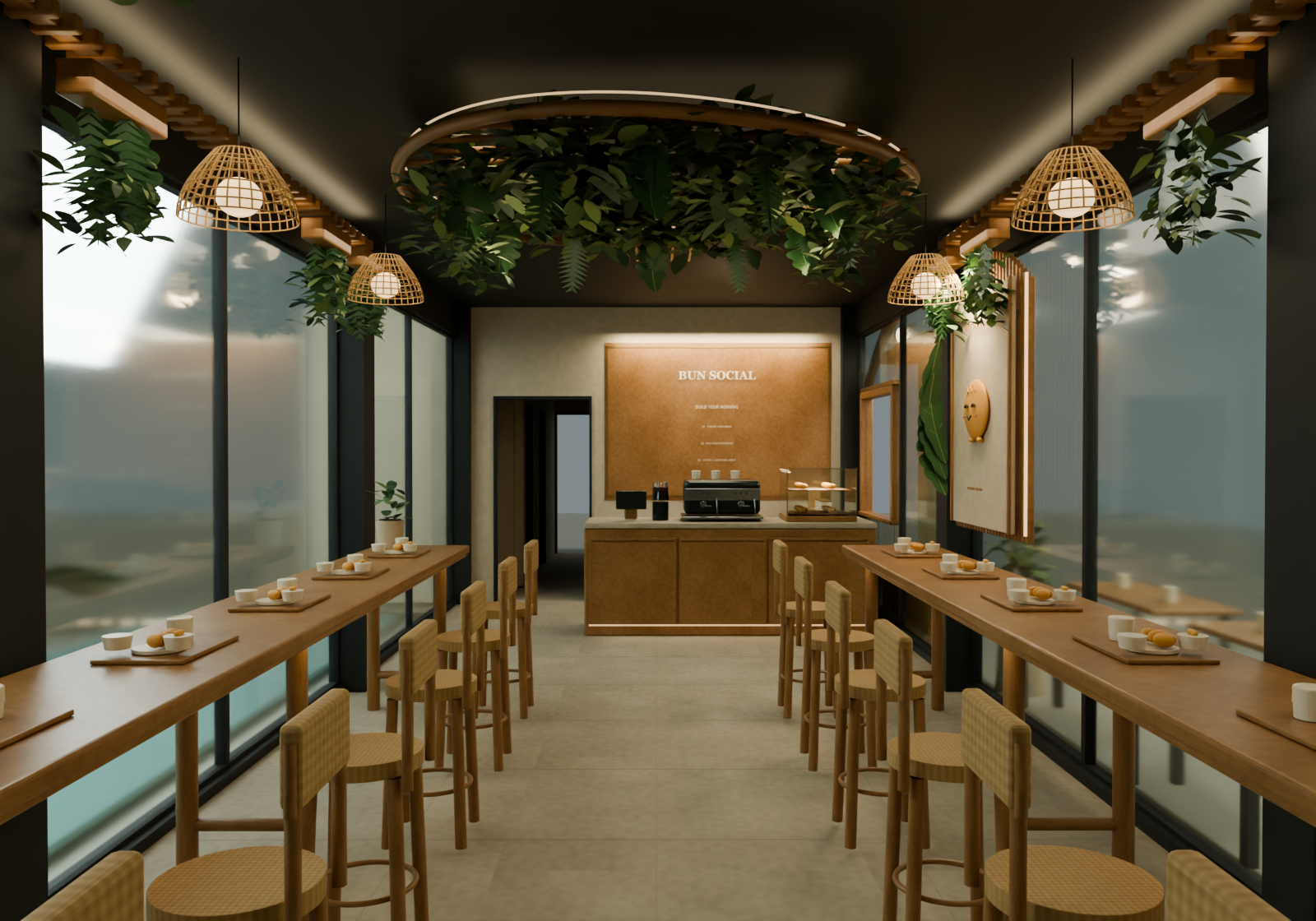
BERAWA, BALI · INVESTOR DESIGN & FEASIBILITY REVIEW
A small café.
A memorable address.
Four distinct worlds for one pool-side space.
Coffee, pastries and guided sandwich choices, built around a recognisable takeaway frontage.
A / BUN SOCIAL · MODEL-BASED DESIGN STUDY19 OCTOBER 2026
01 / MARKET RESEARCH
Canggu brings the audience.
Berawa sets the competition.
A tourism destination with an established café culture. The opportunity is a recognisable, efficient neighbourhood stop that earns repeat visits beyond hotel guests.
MAYA / AN ON-SITE AUDIENCE TO BUILD FROM
75% occupancyA breakfast partnership
at our doorstep.
19 rooms × the operator-reported 75% occupancy ≈ 14 occupied rooms daily. This is a structural opportunity for hotel-paid breakfast vouchers alongside outside customers.
Hotel operator figures · checked 19 Oct 2026 ↗19operator-listed rooms
~13moderate proposed breakfasts/day
Breakfast calculation: 19 rooms × 75% occupancy × 1.5 guests/room × 60% participation = 12.825 redemptions/day. Guest count and participation are assumptions. Occupancy is hotel-reported, not independently audited; it does not guarantee café sales.
Proposed, not contracted: Rp90k per redeemed set, no minimum guarantee. Hotel breakfasts are included within the daytime targets, never added twice.
Compare with and without the partnership ↓Observed walk from Maya to Copenhagen Berawa (~270m). A direct competitor close to the site.
Research route · 18 Oct 2026 ↗A compact social room supports a business led by takeaway, rather than seat count alone.
See the approved spatial layout ↓Province-wide arrivals are context, not measured Canggu footfall. Walking time is a research snapshot. No verified pedestrian count, capture rate or competitor revenue is available for this frontage.
THE CATCHMENT / WORKING HYPOTHESIS
Three reasons to visit.
01
Tourists exploring Berawa
A distinctive storefront, a clear menu and an easy coffee-and-food stop.
02
Nearby residents and workers
Reliable coffee, repeatable lunch choices and fast collection.
03
Maya hotel guests
Proposed hotel-paid breakfast vouchers give a distinct morning channel. Participation and commercial terms remain unagreed.
The next commercial test
Count passing traffic by daypart, test paid orders and repeat purchase, confirm kitchen throughput and negotiate the lease. The night pilot is modelled separately with its own costs; outdoor seats contribute no forecast sales.
Operating brief ↗02 / COMPETITOR RESEARCH
Know the basket.
Understand the business.
Coffee-and-pastry discovery and food-led repeat visits are different revenue engines. Compare six brands, their menu prices, expansion evidence and lessons for Maya.
Published evidence: menus, operator locations and reporting. Analytical estimates: bills, spending mix, occupancy and service assumptions. No competitor POS data or verified revenue is available. Sample means are unweighted averages of named menu options, not actual sales-weighted averages.
The food price context.
Selected advertised menu prices, Rp thousand. Taxes and service differ; these are item benchmarks, not average customer spend.
| Venue / catchment | Illustrative offer | Listed price | Source / price basis |
|---|---|---|---|
| Copenhagen / Berawa | Build-your-own, 3 / 5 / 7 items | 79 / 119 / 165 | Oct 2026 menu ↗+10% tax, +6% service |
| Openhouse / wider market | Scrambled eggs / breakfast burrito | 70 / 95 | Official menu image ↗Receipt tax / service basis unconfirmed |
| Milk & Madu / Berawa | Chicken focaccia / Philly sandwich | 160 / 210 | Jul 2026 lunch menu ↗+10% tax, +7% service; confirm branch offer |
| Revolver / Canggu | Katsu / Italian sandwich | 135 / 150 | Aug 2026 Canggu menu ↗+10% tax, +7% service |
| Deli Sandwich / Canggu | Chicken / pastrami sandwich | 82 / 82 | Official menu ↗Additional tax / service not quantified |
Compare complete bundles as well as premium à-la-carte dishes. Milk & Madu also advertises a Rp110k breakfast/coffee/juice set; confirm conditions. Menu prices may exclude tax/service; no universal final-receipt multiplier is assumed.
BERAWA RENT / ASKING-PRICE BENCHMARK
Our rent needs strong sales productivity.
Five distinct project observations reviewed; only three have explicit building-area fields used in the sample mean/median. Only two of those explicitly advertise café use. This falls short of five confirmed comparable F&B premises. Listings are advertised availability, not agent-confirmed vacant units or signed rents; taxes, operating charges and prepaid commitments differ. Duplicate cross-postings and paired same-project units are not counted twice.
Maya: Rp480m/year ÷ 12 ÷ the drawing’s stated 60m² = Rp666,667/m²/month. Main café room alone is 43.2m², yielding Rp925,926/m²/month of clear sales-room area; that denominator excludes support rooms and is not used in the rental-sample comparison. Labelled rooms already total 58.8m² before passage/storage, so the 60m² lease area requires reconciliation. Hotel audience, road frontage and pool context may add value, but do not establish a justified rent premium.
03 / LAYOUT & DESIGN
Two seating options.
Four distinct worlds.
The approved shell stays fixed. A–D retain the current 12-seat communal furniture; a separate neutral study tests six round low tables and an 18-seat target before changing any themed design.
12 communal seats
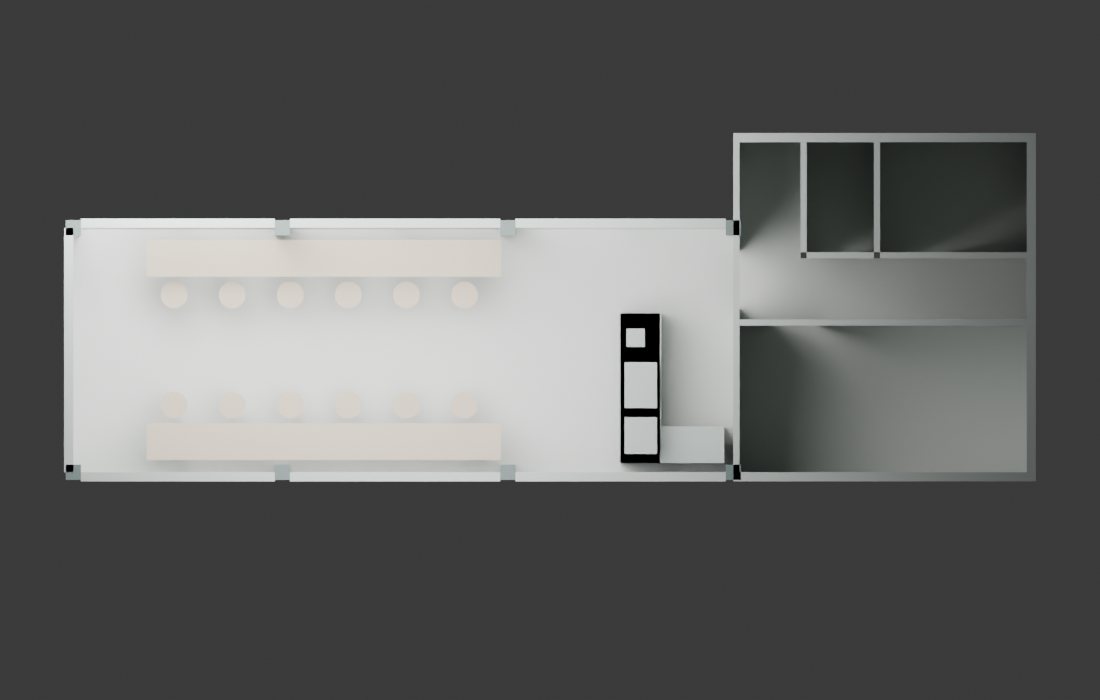
Two 5.80 × 0.60m high tables. This remains the seating shown in all A–D designs.
18 round-table seats
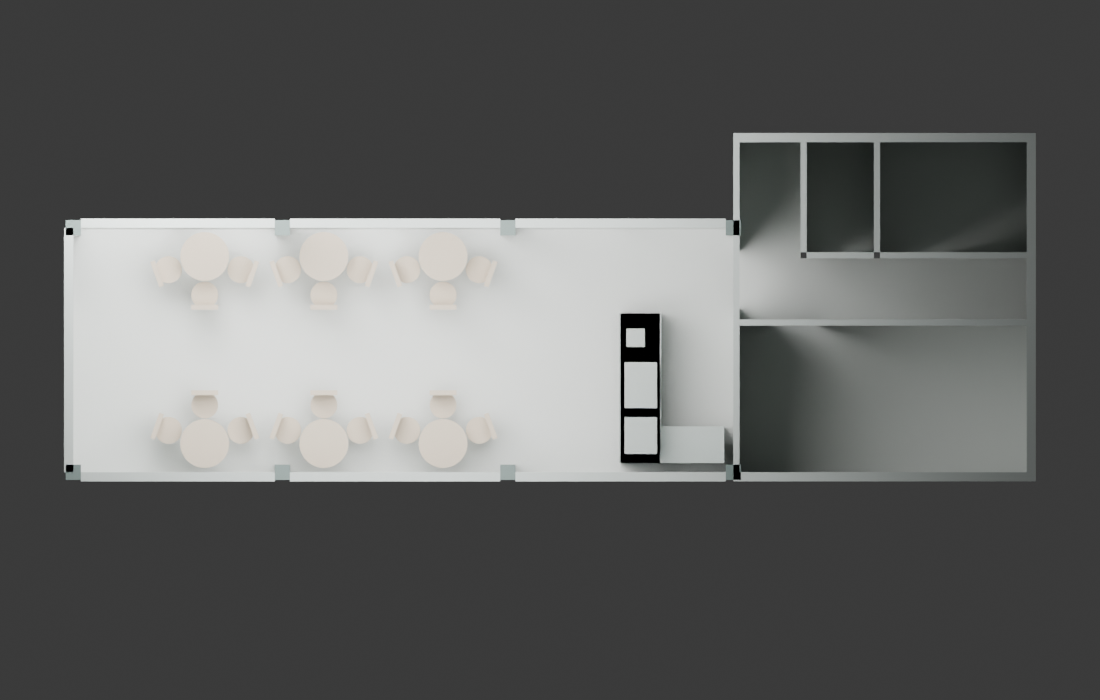
Six Ø800mm low tables × three chairs. Occupied and pull-out zones remain visible; 18 seats are not yet approved.
Review finding: nominal seated aisle 1.20m; opposing chair pull-outs can reduce it to ~0.50m. Outdoor options retain 2 or 3 conditional street-facing perch modules, requiring ~2m usable passage depth.
Review both layouts in 3D ↗BLENDER / MODEL-BASED STUDY · ENLARGE ↗
MATERIAL CHARACTER
Detailed design review ↗THE APPROVED FOUNDATION
Social seating.
A clear central route.
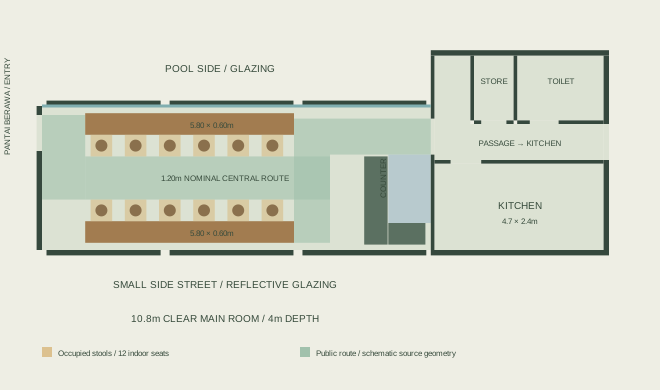
Main room 10.8 × 4m clear. Two 5.80 × 0.60m communal tables and 12 indoor stools. The kitchen is the former “OFFICE”, entered through the passage above it.
1.20mnominal central route
12confirmed indoor seats
Pool at the top; small street at the bottom; Pantai Berawa entry at left. Wall thicknesses, openings and ~3m ceiling remain provisional. The three labelled rooms total 58.8m² before passage/storage; the drawing’s 60m² total is unresolved.
Explore the selected design.
Rotate, change views, inspect occupied seats and routes, hide walls or ceiling, and adjust six lighting zones.
Street seating and exterior alterations are conditional.
Up to 3 removable two-person perches need ~0.80m occupied depth plus a 1.20m walking route (~2m usable strip). They add no confirmed seats or forecast sales. Hatch changes, shade, external photography and D’s pickup hardware need site and supplier coordination.
04 / ORIGINAL BRAND CHARACTERS
A face for every world.
Four new editable 3D mascot studies, shaped for the latest architecture. Working names and digital prototypes; physical sculpture procurement and brand availability remain to be confirmed.
05 / TOTAL INVESTMENT & ROI
The design is compelling.
The economics must earn it.
Selected design: . The same demand assumptions apply to every concept. Architecture is not assumed to create higher sales.
Fit-out and equipment, contingency, prepaid operating rent, pre-opening, opening stock and cash reserve.
See what is included ↓FIT-OUT + EQUIPMENT / INC. 15% CONTINGENCY
QUOTED RENT / BEFORE CONTRACT TAX REVIEWRp40m / month
10 daytime selling hours; 3 additional hours on night-service days = 13, not 14. Initial calendar: 30 trading days + 13 night sessions/month. Night indoor dining is closed. Hotel access, rider availability and the merchant opening schedule still need confirmation.
Sales targets and hotel participation / editable
Daytime targets include breakfast redemptions. Direct takeaway = target − retail dine-in bills − delivery bills − planned hotel redemptions. Turning off the partnership removes redemptions without replacing them with assumed retail demand. Retail demand sensitivity does not scale hotel participation.
Platform fees, packaging and basket costing
All platform terms are unquoted. Customer courier fees are excluded from merchant revenue. Grab and GoFood share one delivery pool; they are not additional orders on top of it. Fees are calculated after merchant-funded discounts, on ex-customer-tax revenue, as a planning convention to check against contracts.
Rp130k is an entry egg-sando + Rp55k drink combination; signature coffees can start at Rp50k. Weighted sandwich price Rp107.5k; drink average Rp55k; complete average combo Rp162.5k. Overall retail bill also includes coffee-only and shared dine-in purchases. Prices are final direct-menu test targets, with a 10% customer-tax provision and no service charge.
Direct basket mix (worst/moderate/best): drink-only 55/45/35%, food-only 20%, balance combos. App mix: drink-only 15/10/5%, food-only 40/35/30%, balance combos. Pastry attaches to 10/15/20% of drink-only orders. Night uses the same channel baskets; no assumed late-night price premium. Dine-in prices and ingredients scale with party size. Pastry Rp35k / Rp17k cost; drink recipe Rp13k. Packaging: drink Rp3k, food Rp4k, combo Rp6.5k; app seal +Rp1.5k; attached pastry +Rp1k; dine-in/hotel consumables Rp500/bill or voucher. Ingredient stress 1.08/1.00/0.96 and separate waste 4/3/2%. Direct payment fee 1%. All supplier costs remain allowances.
Four readable scenarios.
Ambitious mature targets, not measured demand. 07:00–17:00 daily + 02:00–05:00 on 3 peak nights/week. Hotel vouchers, retail bills and delivery are separate; outdoor revenue is zero.
Swipe the table to compare all four scenarios →
¹ Average retail bill includes the customer-tax provision and precedes merchant discounts; hotel vouchers are excluded from this average. ² Break-even scales daytime retail bills at that case’s mix, holding selected hotel and night contributions constant. A bill can cover several people; a hotel voucher is one redeemed meal, not an additional retail bill. Cash surplus includes ingredient costs, packaging, delivery fees, discounts, payroll, operating costs, rent expense/renewal funding, a 22% planning provision on positive surplus and Rp1m/month replacement reserve. ROI is cash-based, not accounting profit, IRR or a promised investor distribution. No financing, ownership terms or exit value assumed.
Channel-by-channel reconciliation
Expected daily averages may be fractional. Hotel vouchers are counted separately even when the hotel settles them in a single invoice. Monthly retail bills = dine-in + direct takeaway + Grab + GoFood, including the selected night sessions.
Required service capacity and night-operation budget
Provisional daytime coverage: 3 positions × (10 selling hours + 1 preparation/cleanup hour) × 7 = 231 staff-hours/week. Six crew × 40 assumed hours = 240 before breaks, leave and training; manager and relief arrangements need a costed roster. Night assumes two additional paid crew for 5 hours/session (3 selling + 2 setup/cleanup), not unpaid daytime overtime. Peak rates require a timed equipment and staffing trial, particularly simultaneous breakfast, coffee and rider pickup.
Rp10m/month allowance at 13 sessions; the calculation scales the entered allowance with session count. Staffing rates, relief, security and hotel access are unverified. Check opening hours, nearby night competitors, night delivery availability and any incremental equipment before committing. Mesa advertises events until 05:00, so a 05:00 close does not capture departures after that time. Mesa hours ↗
Compare the preserved forecast
Earlier assumptions: 07:00–17:00, 45/75/110 retail bills/day, Rp50k beverage average, no hotel or night contribution. Current cases use different targets and baskets; the increase is an assumption change, not observed performance improvement. Old ROI and opening funding do not carry over.
Preserved investor revision ↗Define the combination.
Weight the underlying scenario cash flows, then calculate ROI and payback. Starting weights are judgement-based planning assumptions, not measured probabilities.
Opening year: the ramp matters.
Monthly cash surplus / loss after rent-renewal funding, Rp million. Ramp assumptions are case-specific; mature sales are not assumed from day one.
WorstModerateBestCombination
What the opening cash covers.
Rent is prepaid for 12 operating months. The monthly surplus retains funding for rent renewal; payback asks when all initial funding can be returned while maintaining that protection. The three-month reserve covers non-rent fixed costs including the selected night service. Hotel invoice float conservatively uses the highest scenario’s gross invoices over the assumed payment delay, separately from the stock buffer. Payment terms are unagreed. No extra rent is duplicated in working capital.
Adjust the lease and stress test.
Gross-up is a contract assumption, not an automatic tenant surcharge. Deposit, fit-out rent and rental VAT remain unquoted; zero deposit/fit-out rent does not mean waived. Unrecoverable rental VAT, finance costs and extraordinary losses are excluded and could increase funding.
Itemised design allowance and scope
All amounts are unquoted allowances. Rp500m target / Rp600m ceiling applies to fit-out and equipment including contingency, excluding rent and working capital. Optional scope is not silently absorbed into the ceiling.
Operating assumptions, ROI method and commercial decision gates
Operating model
Six crew plus a hired manager; payroll provisions, relief, utilities, marketing, administration, repairs and cleaning give Rp65.894m/month non-rent fixed costs. Direct takeaway and delivery unit economics include packaging and merchant-funded discounts. Effective delivery fee: 25% assumption. Prices include a 10% customer-tax provision; income-tax reserve is not a statutory liability calculation.
Cash return method
Year-one ROI = sum of ramped monthly surplus ÷ total opening funding. Mature annual cash yield = 12 × steady monthly surplus ÷ that funding. Payback uses cumulative ramped cash, then flat steady cash. Beyond 10 years is shown as “not within 10y”; an indefinite long-range extrapolation is not presented as a dependable return.
What is still missing
Measured conversion, hourly capacity, supplier quotations, employment and tax review, lease term/renewal, utility capacity, construction approvals and the final equipment schedule. Richly themed fit-out may also increase maintenance beyond the common allowance; supplier and operator quotations must test that sensitivity.
Before committing capital
Run a paid pilot, negotiate rent and fit-out terms, obtain coordinated fabrication/equipment quotes and test the peak service system. The selected growth targets need evidence; the stress case tests failure to achieve them. Hotel terms, night demand and staffing remain unverified.
That earlier study used a Rp345m lean fit-out. This landing page uses the selected design allowance plus the revised channel/daypart model. The older workbook is an archived research reference and does not calculate this revision; download current assumptions/results above for the current forecast.
06 / REFERENCES & EVIDENCE
Clear sources.
Visible assumptions.
Research reviewed 19 October 2026. Operator menus support advertised offers; journalism supports observed brand behaviour; architecture remains a model-based design proposal.
Demand context
BPS Bali / August 2026 ↗Maya operator location ↗Perplexity discovery research ↗Discovery findings were checked against linked primary sources. Local sales and passing traffic remain unmeasured.
Reference to interpretation
Gigi Susu / frontage behaviour ↗Sarang Semut / sculpted enclosure ↗NYFA / CyberNeon environment ↗Staff-loaded pickup typology ↗References inform original architecture. D’s compact module is not a quoted or validated Apex product.
Reproducible planning
DJP / rental withholding basis ↗Archived 18 Oct unit economics ↓Current cash-flow calculation source ↓Full research source register ↓Rent gross-up, customer-tax and income-tax provisions require lease and accountant review. No guaranteed return is claimed.
Revision sources / prices, hotel and rental evidence
Earlier research source register
A1/A2 and accepted B/C/D models are retained. New mascot studies are separate. Earlier presentations remain available for comparison.
Preserved previous landing page ↗